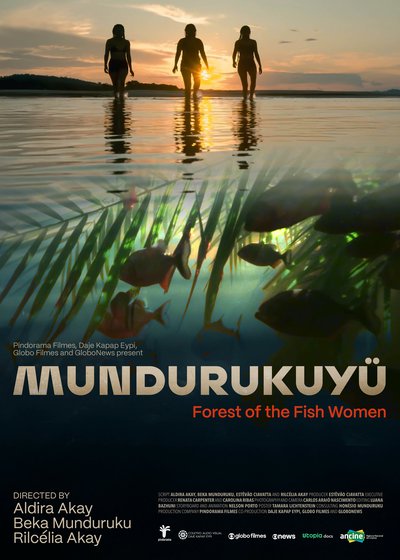
Mundurukuyü – Forest of the Fish Women
Synopsis
<b>The screening will be followed by a talk with the indigenous activists Rilcélia Akay, Luis Painhum Munduruku, and Marco Antonio Motta. </b> <p> Fish women use movie cameras to protect their forest from the forces that destroy it. On the banks of the Tapajós River in the Amazon, the forest of the fish women reflects Munduruku mythology – according to which humans, at the origin of the world, transformed into forest, plants and animals. In the daily life of the Sawre Muybu village, the spirits of the forest are not only ancestral spiritual forces, but part of the family. <p> The Daje Kapap Eypi collective began working with films in 2014, when cameras were used to film the land demarcation of the Munduruku people. Since then, in addition to their political work in favor of indigenous rights, the three directors have been learning how to use technology to defend their territory. Their work can be found on social media, in the short film “Autodemarcação Já!” and now in the feature film MUNDURUKÜYU – FOREST OF THE FISH WOMEN. <p> <b> Directors’ Statement: </b> “For us, the directors, it is important to make this film because we are telling a story that used to be told orally, and today we tell it through documentaries. We, as young indigenous people, are always following the evolution of technology and using these tools in a way that is beneficial to us. Documentaries with stories, talking about the struggle of the Munduruku people, about the invasions that happen within the territory, as a way of taking our voices out. The film MUNDURUKUYÜ – FOREST OF THE FISH WOMEN is very important for us to value our stories, our knowledge through a film and that is really cool because we can take our story to other places. An image, a voice, that can be heard in other corners, not like in the past when we could sit down and listen... which is also very good, but nowadays that is very difficult to happen and we try to keep up with this somehow, so the film has this importance of valuing our culture and our history, which is still very much alive despite many years of invasion, of destruction within the territory. We have not yet lost our language, our stories, our sacred places, and we continue to resist. Sawé!”